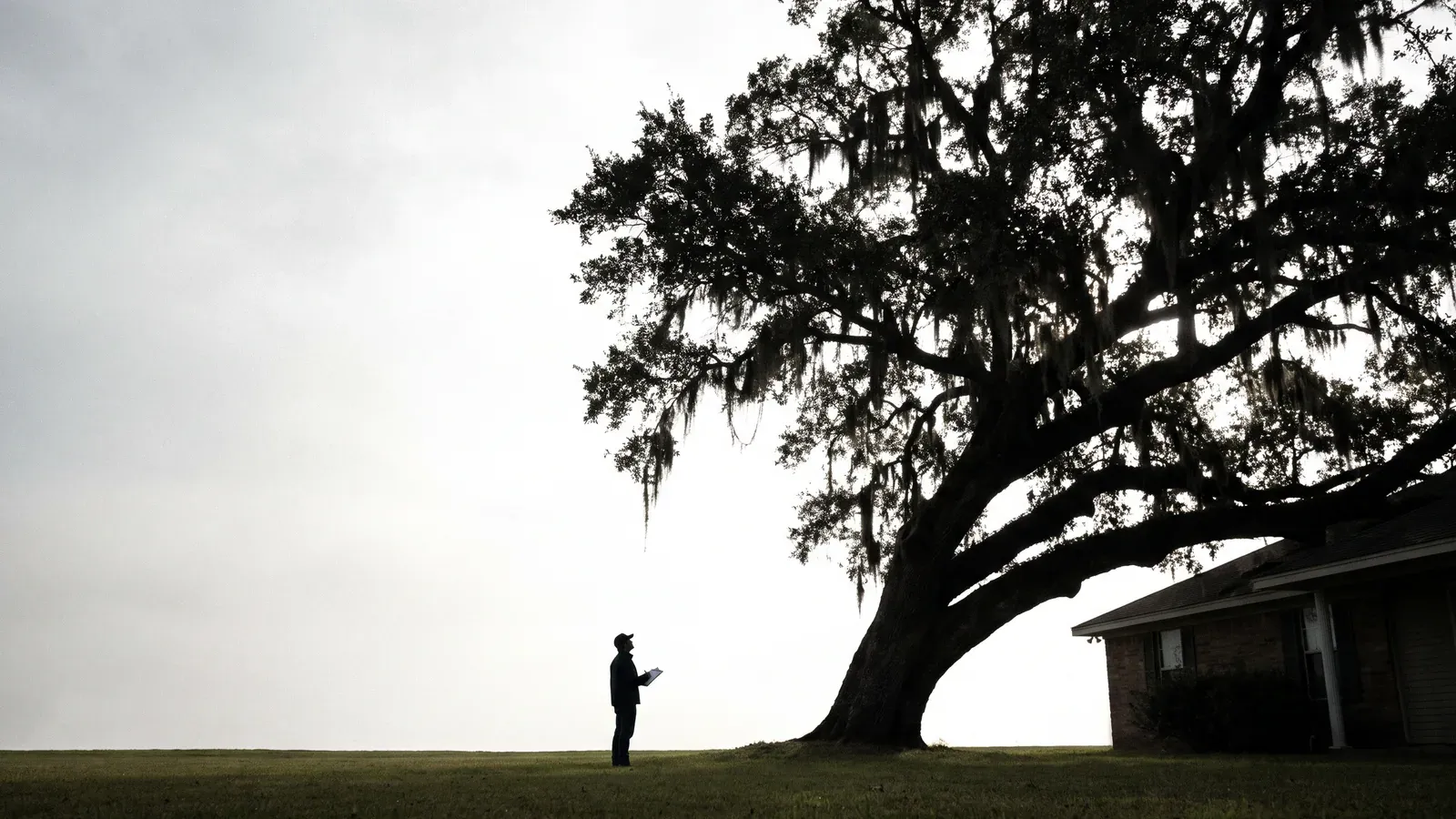
Standing-tree inspection
Tree Risk Assessment for Standing Trees in Lafayette and Acadiana
Louisiana Tree Masters provides tree risk assessment for homeowners and businesses in Lafayette, Youngsville, and across Acadiana. A Louisiana-licensed arborist (License #26-0706) reads a tree's structure, what it threatens, and what it would take to fail, and gives you a straight answer while the tree is still standing. Free estimates are available.
Credential recordLICENSE #26-0706
Field recordSINCE 1994
Every risk call starts with the license, not a hunch.
The read
What a risk assessment covers, in order.
A tree can look sound from the ground. The inspection works through structure, target, and site before any recommendation is made.
- 01
Read the structure
Trunk, limbs, and root flare are checked for cracks, cavities, decay, and weak branch unions, the conditions that raise the odds of failure.
- 02
Read the target
What sits underneath matters as much as the tree itself: a roof, a driveway, a play area, or open yard changes what the risk means.
- 03
Read the site
Lean, soil movement, and root damage from nearby construction or trenching are weighed alongside the tree's own condition.
- 04
Get a straight recommendation
Monitor, prune, cable, or remove, explained in plain terms and put in writing.
Operations index
What tree risk assessment covers
Every assessment is a standing-tree inspection. Nothing on this list assumes the tree has already failed.
-
Leaning and shifting trees
A trunk that leans more than it used to, or roots lifting from the soil, can mean the structure underneath has changed.
-
Cracks, cavities, and decay
Trunk wounds, hollow sections, and fungal growth near the base are exactly what the inspection is built to catch.
-
Trees near structures
A tree over a roof, driveway, fence, or play area gets a closer read, because what it threatens changes what the risk means.
-
Weak branch unions and canopy imbalance
Heavy limbs with poor attachment points or a lopsided crown carry risk that is easy to miss from the ground.
-
Pre-hurricane-season inspections
A standing tree's structure checked ahead of storm season, not after wind has already made the call.
Field assessment
Tell us what you're seeing.
Describe the lean, the crack, the limb, or the tree itself, and what it sits near. A licensed arborist reviews every risk request.
Risk answers
Frequently asked questions about tree risk assessment
01 What is a tree risk assessment?
A tree risk assessment is an inspection of a standing tree's health, structure, roots, and site conditions, looking for anything that raises the odds of limb or trunk failure. It considers the tree together with what is nearby: a home, a driveway, a fence, or an open yard.
02 Does a hazardous tree always need to come down?
No. Some trees can be managed with pruning, deadwood removal, cabling, or ongoing monitoring. If the root system, trunk, and main structure are sound, keeping the tree is often possible. Removal is reserved for trees where the risk cannot be managed another way.
03 When should I have a tree inspected?
It is worth scheduling an inspection if a tree is leaning, cracked, declining, or growing close to a home, driveway, or business, and it is smart to have trees checked ahead of hurricane season rather than after one.
04 Can a risky tree be saved?
Often, yes. A tree with dead limbs, minor structural issues, or poor branch attachment can frequently be managed with pruning, weight reduction, or monitoring, if the trunk and root system are still sound.
05 Which areas do you cover for tree risk assessment?
Tree risk assessment is available across Lafayette, Youngsville, and the wider Acadiana area, for homeowners, businesses, and property managers.
Before it fails
Read the tree while it's still standing.
A licensed arborist can inspect a tree in Lafayette, Youngsville, or anywhere across Acadiana and give you a straight answer on what it needs, before a storm makes that call instead. Free estimates.